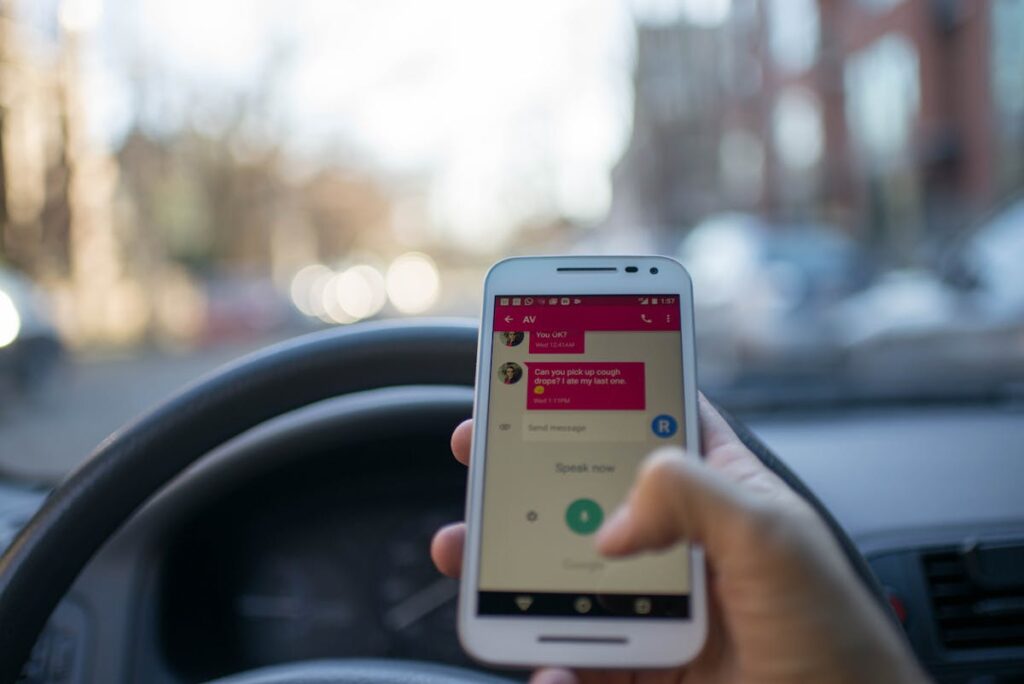
Distracted driving has become one of the leading causes of accidents in Arizona. Despite laws prohibiting texting while driving, thousands of Phoenix-area crashes each year involve drivers who were looking at their phones, eating, adjusting GPS devices, or engaging in other distracting activities. These preventable accidents cause serious injuries, deaths, and devastating financial consequences for victims and their families.
Arizona’s Distracted Driving Laws
Arizona has specific laws addressing distracted driving, though they’re less comprehensive than some other states:
Texting While Driving Ban (A.R.S. § 28-914)
Arizona law prohibits:
- Texting while driving: Reading, writing, or sending text messages
- Applies to all drivers: No age restrictions
- Primary offense: Officers can stop you solely for texting
- Penalties: $75-$149 for first offense, $150-$250 for subsequent offenses
Important exceptions:
- Emergency situations (calling 911)
- Stopped at a red light or stop sign
- Parked vehicle
- Voice-activated or hands-free technology
What Arizona Law DOESN’T Ban
Unlike many states, Arizona does not prohibit:
- Talking on handheld cell phones (except for teen drivers)
- Using GPS or navigation apps while driving
- Checking email or social media (though this falls under general reckless driving)
- Taking photos or videos while driving
However, these activities can still form the basis of negligence claims if they cause accidents.
Teen Driver Restrictions (A.R.S. § 28-3174)
Drivers under 18 with learner’s permits or graduated licenses face stricter rules:
- No cell phone use while driving (including hands-free)
- No texting, calling, or any phone functions
- Exception only for emergencies
- Violations can delay full license eligibility
School Bus and Construction Zone Restrictions
- Enhanced penalties for distracted driving in school zones
- Construction zone violations carry doubled fines
- School bus drivers prohibited from all cell phone use
Types of Distracted Driving
Distraction falls into three categories, often occurring simultaneously:
Visual Distractions (Eyes Off Road)
- Cell phone use: Looking at texts, emails, social media
- GPS devices: Programming navigation or reading directions
- Passengers: Turning to look at backseat passengers
- External distractions: Accidents, billboards, scenery
- Reading: Maps, documents, books
- Personal grooming: Checking mirrors for makeup or shaving
Manual Distractions (Hands Off Wheel)
- Texting: Typing messages
- Eating and drinking: Handling food or beverages
- Adjusting controls: Radio, climate, seat position
- Reaching for objects: Items in glove box, backseat, or floor
- Smoking: Lighting cigarettes or handling smoking materials
- Pet interactions: Restraining or petting animals
Cognitive Distractions (Mind Off Driving)
- Phone conversations: Even hands-free calls reduce focus
- Daydreaming: Mind wandering to other thoughts
- Emotional distress: Stress, anger, or sadness affecting concentration
- Passenger conversations: Engaging discussions diverting attention
- Listening to audio: Podcasts, audiobooks requiring mental focus
Common Distracted Driving Accidents in Phoenix
Rear-End Collisions
The most common type of distracted driving accident:
- Driver fails to notice stopped or slowing traffic
- Particularly common at red lights and in congestion
- Often occurs on I-10, Loop 101, and major surface streets
- Can cause chain-reaction crashes involving multiple vehicles
Intersection Accidents
Distracted drivers running red lights or stop signs:
- T-bone collisions causing severe injuries
- Failure to yield right-of-way
- Not seeing pedestrians in crosswalks
- Common at Phoenix’s busiest intersections
Lane Departure Crashes
Drifting out of lane due to inattention:
- Sideswiping adjacent vehicles
- Head-on collisions from crossing center line
- Running off roadway into barriers or poles
- Particularly dangerous on highways at high speeds
Pedestrian and Cyclist Accidents
Distracted drivers failing to see vulnerable road users:
- Hitting pedestrians in crosswalks
- Right-turn-on-red accidents
- Parking lot collisions
- Cyclists struck from behind or during lane changes
Hit by a Distracted Driver?
Proving distraction requires thorough investigation and evidence gathering. Contact Shapiro Injury Law for a free consultation. Our Arizona attorneys will obtain cell phone records, witness statements, and other evidence to prove the driver was distracted. No fees unless we win.
Proving Distracted Driving in Arizona Accident Cases
Establishing that a driver was distracted requires solid evidence:
Cell Phone Records
The most powerful evidence in distracted driving cases:
- Call logs: Show incoming/outgoing calls at time of crash
- Text message records: Prove texting immediately before accident
- Data usage: Demonstrate app use, web browsing, or social media
- GPS data: Confirm phone was in moving vehicle
How to obtain records:
- Subpoena phone carrier for detailed records
- Forensic examination of driver’s phone (if preserved)
- Court orders for social media activity logs
- App data from Facebook, Instagram, Snapchat, etc.
Witness Testimony
- Other drivers who saw the at-fault driver on their phone
- Passengers in the at-fault vehicle
- Pedestrians who observed the driver’s behavior
- Statements about driver looking down or not watching road
Police Reports
- Officer observations at the scene
- Driver admissions about phone use or other distractions
- Citations for texting while driving
- Witness statements recorded by police
Accident Reconstruction
- Lack of skid marks indicating no braking attempt
- Speed analysis showing no reduction before impact
- Impact angles consistent with inattention
- Expert testimony about reaction times
Video Evidence
- Traffic camera footage
- Dash cam video from your vehicle or others
- Security cameras from nearby businesses
- Red light cameras at intersections
Driver’s Own Statements
- Admissions at the scene
- Social media posts about the accident
- Statements to insurance adjusters
- Deposition testimony in lawsuits
Compensation for Distracted Driving Accident Victims
Economic Damages
- Medical expenses: Emergency care, surgery, hospitalization, therapy
- Future medical costs: Ongoing treatment and rehabilitation
- Lost wages: Income lost during recovery
- Lost earning capacity: Reduced ability to work
- Property damage: Vehicle repairs or replacement
Non-Economic Damages
- Pain and suffering: Physical pain from injuries
- Emotional distress: Anxiety, depression, PTSD
- Loss of enjoyment of life: Inability to participate in activities
- Disfigurement: Permanent scarring or physical changes
- Loss of consortium: Impact on family relationships
Punitive Damages
Available when distraction rises to extreme recklessness:
- Repeated texting while driving despite near-misses
- Watching videos while driving
- Livestreaming while driving
- Texting while driving in school zones
- Prior accidents or citations for distracted driving
Arizona Comparative Negligence in Distracted Driving Cases
Arizona follows pure comparative negligence rules:
- You can recover even if partially at fault
- Your compensation is reduced by your percentage of fault
- Example: 70% at fault = recover 30% of damages
- Even 99% at fault = still recover 1%
Common defense arguments:
- “You were also on your phone”
- “You could have avoided the accident”
- “You were speeding”
- “You weren’t paying attention either”
An experienced attorney can counter these arguments and minimize your assigned fault percentage.
Frequently Asked Questions
Can I sue for distracted driving if the driver wasn’t cited?
Yes. Police citations are not required to file a personal injury lawsuit. Many distracted driving accidents don’t result in tickets, especially if officers don’t witness the phone use. Your attorney can obtain cell phone records and other evidence to prove distraction even without a citation.
How long do I have to file a distracted driving accident lawsuit in Arizona?
Arizona’s statute of limitations is 2 years from the accident date for personal injury claims. However, don’t wait—cell phone records may be deleted, witnesses’ memories fade, and evidence disappears. Contact an attorney immediately after your accident.
What if the driver was using hands-free technology?
Hands-free phone use is legal in Arizona for adult drivers, but it can still constitute negligence if it caused the accident. Studies show hands-free conversations are nearly as distracting as handheld calls. If the driver was cognitively distracted by a phone conversation and caused a crash, they can still be held liable.
Can I get the other driver’s cell phone records?
Yes, through the legal discovery process. Your attorney can subpoena cell phone records from the driver’s carrier showing calls, texts, and data usage at the time of the accident. This often provides the strongest evidence of distraction.
What if the distracted driver was working when the accident happened?
If the driver was working (delivery driver, sales rep, etc.) and was distracted by work-related phone use, their employer may be liable under vicarious liability principles. This can significantly increase available insurance coverage and compensation.
How much is my distracted driving accident case worth?
Case value depends on injury severity, medical expenses, lost wages, pain and suffering, and other factors. Distracted driving cases may warrant higher compensation because the behavior is preventable and often egregious. Punitive damages may also be available in extreme cases. Contact an attorney for a free case evaluation.
Contact Shapiro Injury Law today for a free consultation. Our experienced Arizona personal injury attorneys know how to prove distracted driving and maximize compensation for injured victims. We’ll obtain cell phone records, interview witnesses, and build a strong case against the at-fault driver. We serve clients throughout Phoenix, Scottsdale, Mesa, Tempe, and all of Maricopa County. No fees unless we win.